Jamming and spoofing on everyday routes
Since late 2023, GPS in parts of Israel can freeze, jump or put a vehicle kilometres from where it really is. A driver who can’t trust the map slows down, drives from memory or calls for directions.
האתר זמין גם בעברית
For Israeli defence, homeland-security and law-enforcement organisations. Navato keeps guiding drivers through jamming, spoofing, tunnels and underground car parks, with the full map on the phone and no network needed.
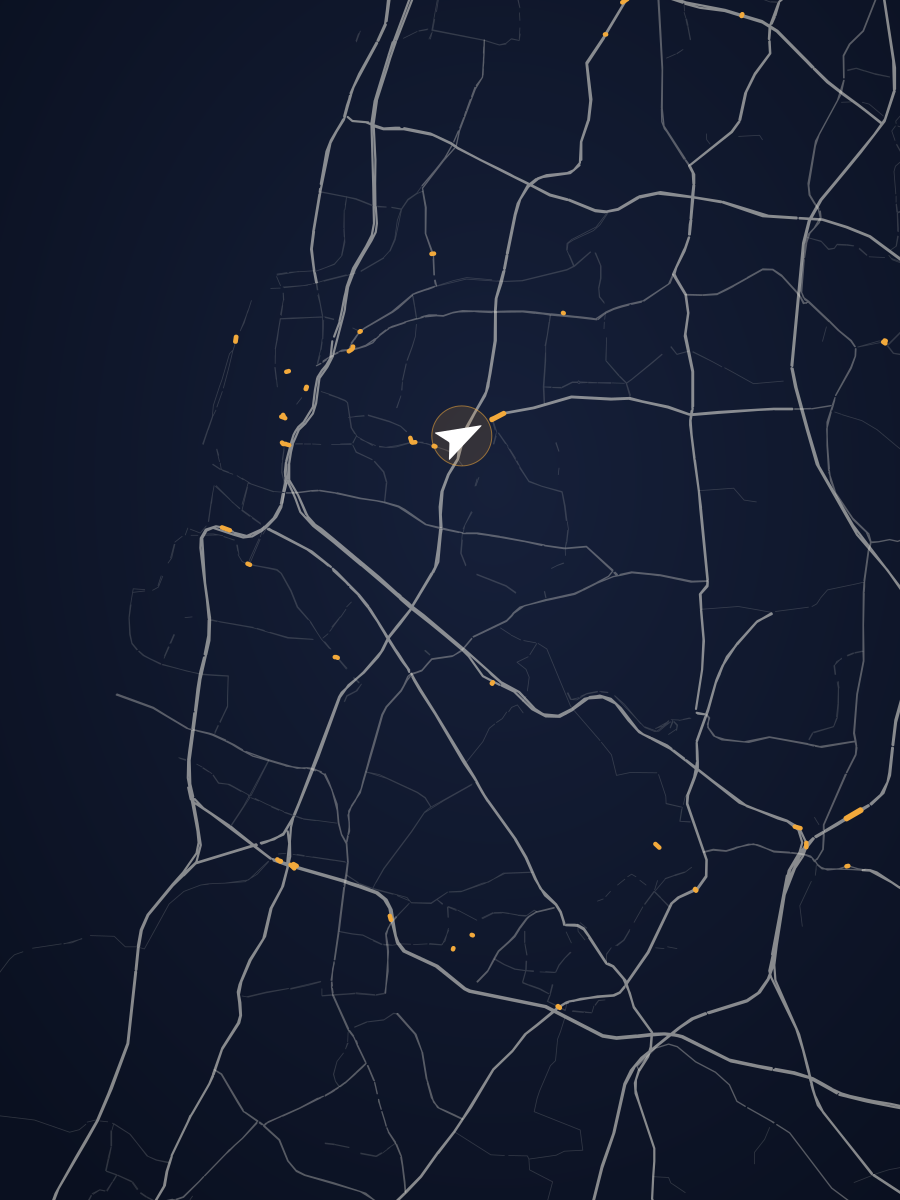
Since late 2023, GPS in parts of Israel can freeze, jump or put a vehicle kilometres from where it really is. A driver who can’t trust the map slows down, drives from memory or calls for directions.
In an emergency, mobile networks can get congested or go down, and some organisations keep work phones off the mobile network altogether. Navigation that depends on data or a server stops when it’s needed most.
When navigation searches for an address, plans a route or shows traffic through a server, it sends that server the vehicle’s position. In a security organisation, each of those requests is a question for the security and information-security officers.
Local authorities and government bodies face the same jamming. The pilot works the same way. Government and local authorities
Navato is in beta and is not certified for operational, emergency, professional or other safety-critical use. In a pilot it runs alongside the navigation and procedures your units already rely on, never in place of them.
Pilots offered on this page are open only to Israeli defence, homeland-security and law-enforcement organisations. Each engagement is subject to the organisation’s own security requirements and to applicable Israeli law.
Choose a few vehicles and the kinds of places that trouble your teams: an area with GPS jamming, an underground car park, a tunnel on a main route. We agree the success criteria in advance, and you decide what happens next.
Navigation needs no server. Navato reports vehicle locations only from phones where live location reporting is switched on. Sharing and live location reporting are off by default on every phone, and your pilot procedure can keep them off for the whole pilot. Questions from your security officers? Include them in your pilot request, and we’ll go through them with you.
Security and privacyNavato is built to keep guiding through jamming and spoofing, and it reroutes only when the vehicle has really left the route, so a false position can’t send a driver the wrong way. We don’t publish accuracy figures yet; in a pilot we measure on your routes, against your criteria.
Yes, for navigation. The map, address search, routing and spoken directions run on the phone, and Navato goes online while it guides a vehicle only if live location reporting is switched on. It works on a phone with no SIM card. When the vehicle is parked and the phone is online, the app asks navato.ai for its settings and announcements and, unless you turn them off, downloads community updates that are the same for every phone. These requests carry nothing about your drives; our hosting provider sees the phone’s IP address to answer them. How data is handled.
No drive data leaves a vehicle unless sharing or live location reporting is switched on. Sharing has three separate switches on every phone and live location reporting is a separate setting, all off by default, and your pilot procedure can keep them off for the whole pilot. If sharing is switched on, shared data is stored on servers in Frankfurt, Germany, in the EU, and AI analysis by Anthropic in the United States, when enabled, receives trip summaries with no coordinates, dates, IDs or IP addresses. Navato reports a vehicle’s location only if live location reporting is switched on on that phone. How data is handled.
Yes. The privacy policy, the terms of use and the full permission list are public, and before the pilot we go through your security team’s questions with them and agree the setup in writing.
No. Navato is in beta and is not certified for operational, emergency, professional or other safety-critical use, so in a pilot it runs alongside the navigation and procedures your units already rely on.
Israeli defence, homeland-security and law-enforcement organisations only. Each engagement is subject to the organisation’s own security requirements and to applicable Israeli law. The vehicles, the period and the data settings are agreed in writing before anything starts. Navato is developed in Israel and tested on Israeli roads.
Tell us about your organisation and the kinds of vehicles you’d like to evaluate. Please don’t send classified or security-sensitive details, such as unit names, sites or routes, through this website.